
Short answer: No option is always the cheapest. In the worked example below (45 people, a 200 km return day trip from downtown Toronto, eight hours door to door), carpooling cost the least: $29.20 per person counting the full cost of using personal cars, or $6.36 per person in fuel alone. Renting four 12-passenger vans came to about $44.47 per person before insurance. A charter coach at a mid-range published rate came to about $54.67 per person. Published coach rates varied so widely that the same charter could cost anywhere from $30.61 to $71.07 per person.
A charter bus gives you one professional driver and one vehicle, and the group travels together. Those are real logistical advantages, but they don’t automatically make it cheaper. Which option costs least for your group depends on the quotes you get, the distance, how long you need the vehicles, parking and tolls, and whether you have enough willing, properly licensed drivers.
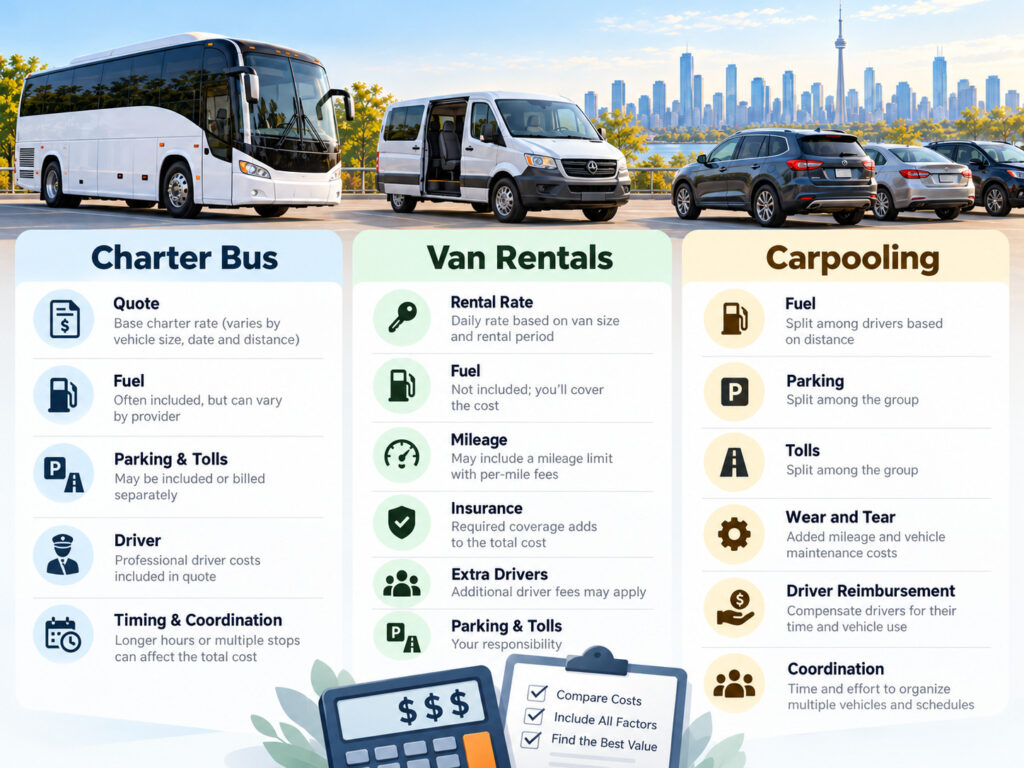
Factor | Charter bus | Van rentals | Carpooling |
Number of vehicles needed | Usually one vehicle sized to the group. A second vehicle is needed if passengers or luggage exceed its seated capacity. | Several. Divide total people (including drivers) by the seats in each van and round up. | The most. A typical car seats five including the driver, so plan on at least one car for every five people. |
Main cost components | The charter fee (hourly with a minimum, daily or per trip), plus HST, gratuity and anything the quote excludes. | Rental rate per van, kilometre charges above any included allowance, fuel, insurance or protection products, additional-driver fees and HST. | Either fuel only (the cash cost) or an all-inclusive per-kilometre reimbursement that already covers fuel and wear. Count one or the other, not both. Add parking and tolls if they’re not covered. |
Fuel and parking considerations | Some operators include fuel in the base rate, while others add a surcharge, so confirm it. One vehicle to park, and it can often drop passengers at the door. | You pay fuel for every van and need one parking space per van. | Fuel for every car, and one parking space per car. |
Number of drivers required | One professional driver provided by the operator. Long days may need a second driver or a planned rest break. | One volunteer driver per van from your group. In Ontario, a 15-passenger van requires a Class F licence. | One volunteer driver per car from your group. |
Passenger coordination | One pickup time and place, or one planned route of stops. | You assign people to vans, collect keys, coordinate departure and plan the return. | Many departure points, times and routes to coordinate. |
Keeping the group together | Keeps the group travelling together in one vehicle. | Vans can get separated in traffic, so arrival times can vary. | Arrivals are usually spread out. |
Best-suited group sizes or situations | Groups that would otherwise need three or more vehicles, longer trips, trips with luggage, and events where everyone must arrive together. | Groups of roughly 15 to 30 that have enough qualified, willing drivers and some flexibility on arrival times. | Small groups on short local trips, with free or cheap parking and drivers who are happy to drive. |
Potential hidden costs | Exclusions such as gratuity, tolls, parking, overtime, fuel surcharges, and driver meals or accommodation. | Insurance, kilometre overages, refuelling charges, damage deductibles, extra-driver fees, and the time it takes to pick up and return each van. | Paid parking and 407 ETR tolls for each car, plus the unpaid time of every driver. |
Cost per person in our 45-person example | $54.67 at $250/hour (published rates gave $30.61–$71.07) | $44.47 (insurance and extra-driver fees not included) | $29.20 using a per-km reimbursement, or $6.36 in fuel only |
A lower price per vehicle doesn’t mean a lower total for the group, and neither does using fewer vehicles. A van costs less to rent than a coach costs to charter, but you need several vans. A coach replaces those vans, but its fee includes a professional driver’s time, which volunteer drivers don’t charge for. Compare the total cost of moving everyone on the same trip.
This is an illustrative example, not a quote. It uses published third-party rates and stated assumptions. The figures are not Zen Bus Lines’ prices and don’t represent the whole Toronto market. Real costs depend on your route, date, vehicle availability, rental terms and what each quote includes.
Assumption | Value |
Group size | 45 people (organizers and drivers included) |
Route | Downtown Toronto to a venue about 100 km away and back on the same day (200 km in total) |
Duration | 8 hours from first pickup to final drop-off |
Parking | Free at the venue for all vehicles (the effect of paid parking is shown below) |
Tolls | None, since the route avoids Highway 407 ETR |
Fuel price | Regular gasoline at $1.767/L, the Ontario government’s weekly survey price for Toronto on 19 October 2026 (survey prices include taxes) |
HST | 13% added to charter and rental fees. Not added to fuel or per-km reimbursement (see the tax note below). |
Option | Vehicles | Seats | Drivers |
Charter bus | 1 full-size coach (50+ seats) | 50+ | 1 professional driver supplied by the operator |
Van rentals | 4 × 12-passenger vans (45 ÷ 12 = 3.75, rounded up) | 48 including drivers | 4 volunteers from the group |
Carpooling | 9 × 5-seat cars (45 ÷ 5 = 9) | 45 including drivers | 9 volunteers from the group |
Nine cars only works if every seat is full. In practice you’ll often need more, which raises the carpooling cost.
Line item | Calculation | Amount |
Charter fee | $250/hour × 8 hours | $2,000.00 |
HST | 13% × $2,000.00 | $260.00 |
Driver gratuity | 10% of the pre-tax charter fee | $200.00 |
Fuel, tolls, parking | Assumed included in the charter fee, or not applicable on this route | $0.00 |
Total | $2,460.00 | |
Per person | $2,460.00 ÷ 45 | $54.67 |
The $250/hour rate sits within the published ranges we found for Toronto coaches. Top Bus lists CAD 140–280 per hour, and Chauffeuropolis lists rates “from $250/hr” (with $325/hr for its 56-seat coach). Applying the same method to the lowest and highest published hourly rates gives a total of $1,377.60 at 140/hour(30.61 per person) and $3,198.00 at 325/hour(71.07 per person). A 15% gratuity instead of 10% would add $100 to the $250/hour total.
Line item | Calculation | Amount |
Rental | $389.99/day × 4 vans | $1,559.96 |
Kilometres over the daily allowance | (200 km − 150 km included) × $0.18/km × 4 vans | $36.00 |
HST | 13% × $1,595.96 | $207.47 |
Fuel | 200 km × 14 L/100 km = 28 L per van × 4 vans = 112 L × $1.767 | $197.90 |
Insurance or protection products | Not published by the rental company | Not included |
Additional-driver fees | Not published by the rental company | Not included |
Total (excluding insurance and extra-driver fees) | $2,001.33 | |
Per person | $2,001.33 ÷ 45 | $44.47 |
The rental rate, kilometre allowance and overage charge come from City Car and Truck Rental’s published listing for a 12-passenger high-roof van (Ford Transit or similar). The listing also requires a $500 refundable security deposit per van, which isn’t a cost. No one publishes a fuel-economy rating for 12-passenger vans, so the 14 L/100 km figure is an assumption. Each 1 L/100 km difference changes the fuel cost by about $3.53 per van.
Use one method, not both:
Method | Calculation | Total | Per person |
A. All-inclusive reimbursement (covers fuel, wear and other vehicle costs) | 9 cars × 200 km × $0.73/km | $1,314.00 | $29.20 |
B. Fuel only (the cash cost if drivers aren’t reimbursed for wear) | 9 cars × 200 km × 9 L/100 km = 162 L × $1.767 | $286.25 | $6.36 |
Method A uses the 2026 per-kilometre rate the federal government sets for tax-exempt employer allowances (73¢ for the first 5,000 km). It’s a benchmark for the full cost of using a personal vehicle, so fuel is not added on top. Method B leaves out wear, maintenance and depreciation, which drivers still absorb. The 9 L/100 km figure is an assumed average for a typical car.
Under these assumptions, carpooling is the cheapest option, van rental comes next, and the mid-range charter quote is the most expensive. The difference mostly comes from drivers. The charter fee pays a professional driver for eight hours. The van and carpool totals rely on 4 or 9 volunteer drivers whose time isn’t counted.
The charter’s advantages here are logistical, not financial: one vehicle, one driver, no Class F licences or van insurance to arrange, and the group travelling together. A low published charter rate (30.61perperson)would nearly match carpooling with full reimbursement (29.20 per person) and cost less than the vans. That’s why written quotes matter more than general rules.
If a quote you receive already includes HST, don’t add it again.
With vans, the rental rate is only the starting point. You pay for each vehicle separately, cover fuel and extras yourself, and supply a properly licensed driver for every van. A charter quote usually covers the vehicle and a professional driver, so the main question is what it excludes. If you’re wondering whether it’s cheaper to rent a bus or vans, the only reliable answer comes from adding up both totals for the same trip, as in the example above.
| Vehicle type (total seats, including driver) | Calculation | Vehicles needed for 50 people | Drivers needed |
| 15-seat passenger van | 50 ÷ 15 = 3.3 | 4 | 4 (each needs a Class F licence in Ontario) |
| 12-seat passenger van | 50 ÷ 12 = 4.2 | 5 | 5 |
| 7-seat minivan | 50 ÷ 7 = 7.1 | 8 | 8 |
| 5-seat car | 50 ÷ 5 = 10 | 10 | 10 |
| One coach with 50 or more passenger seats | 1 | 1 | 1 professional driver (not from your group) |
Don’t assume a van rental price includes insurance, damage coverage or extra drivers. Collision or liability products, deductibles and additional-driver fees can all apply, and you pay them for every van. If you plan to rely on a personal auto policy or a credit card’s rental coverage, check in writing that it covers the vehicle type you’re renting. With a charter, the operator insures and operates the vehicle. Ask for a certificate of insurance if your employer, school or venue needs one.
This can decide whether van rental is an option at all.
Availability is limited too. Enterprise, for example, states that 12- and 15-passenger vans “are not rented in Canada“, and the Toronto rental listing used in our example offers a 12-passenger van but no 15-passenger model. Check what local branches actually offer before you plan around large vans.
Every van needs a parking space, and Highway 407 ETR charges each vehicle separately. Heavier vehicle classes pay higher per-kilometre rates, so check the current 407 ETR rate chart, and ask the charter operator whether tolls are included. Renting vans also takes volunteer time: picking up each vehicle, completing the paperwork, driving in convoy, refuelling and returning the vans. None of that appears on a receipt.
Often, yes, in cash terms. In our worked example, carpooling was the cheapest option whichever way the driving costs were counted. The vehicles already exist and the drivers aren’t paid. What carpooling costs in other ways is coordination: more vehicles, more drivers and more parking spaces.
There are two legitimate ways to cost a carpool. Use one per vehicle and trip:
Parking and tolls are usually separate from a per-km reimbursement. Check what your organization’s policy covers, and list parking and tolls separately if they’re excluded.
At downtown Toronto venues, airports, stadiums and event sites, parking can become a large part of the carpooling total, because every car pays its own rate. Any car using Highway 407 ETR pays its own toll. A charter bus usually drops passengers at the entrance, though bus parking or layover fees may still apply.
Carpooling needs enough people who are willing to drive, stay sober at a wedding or celebration, and handle traffic or winter roads. Cars rarely fill evenly, so you often need more vehicles than the headcount suggests. Separate cars also take different routes and arrive at different times. For a ceremony, a game warm-up or a corporate session, that’s a scheduling cost even when it isn’t a financial one.
Carpooling is usually the lowest cash cost for groups that already have enough cars and willing drivers. It’s most practical when the trip is short, parking is free or cheap, and arriving at slightly different times doesn’t matter. It becomes harder to manage when you need many cars, parking is limited, alcohol is involved, or the group needs to arrive together. In those cases, get a quote for an event or wedding shuttle service and compare it with your carpool total.
The cheapest way to transport a large group is whichever option has the lowest total for your specific trip. As the worked example shows, that’s often carpooling or vans when volunteer drivers are available, but the answer can change with the quotes you receive. Group size mainly changes how many vehicles and drivers each option needs, and that’s where most cost differences come from.
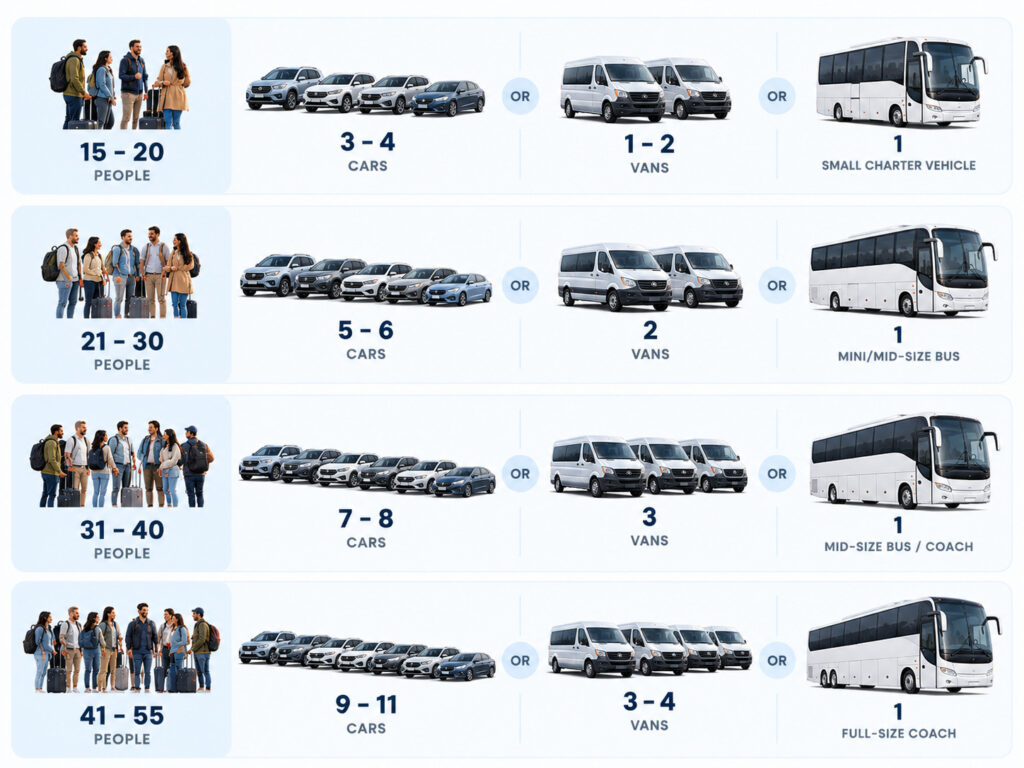
Group size | Cars if carpooling (5 seats each) | 15-seat vans needed | Charter vehicle to ask about | Main cost factor to check |
15–20 | 3–4 | 1–2 | Sprinter van or mini bus | Hourly minimums vs. parking and driver availability |
21–30 | 5–6 | 2 | Mini bus or mid-size bus | Number of Class F–eligible drivers you can provide |
31–40 | 7–8 | 3 | Mid-size bus or coach | Fuel, parking and insurance across several vehicles |
41–54 | 9–11 | 3–4 | Full-size coach (Zen Bus Lines lists 54 seats) | Charter quote vs. reimbursed carpool and van totals |
55 | 11 | 4 | One 54-seat coach is one seat short, so you need a confirmed additional vehicle | Availability and cost of the extra vehicle |
Vehicle counts assume every seat, including the driver’s, is filled and that no luggage takes up seats. Real-world counts are often higher.
Use the same group size, route, date and timing for every option. Leave a cost out if it’s already included in a quote, and never add a cost twice.
Total group transportation cost = vehicle or charter cost + costs not already included (fuel, kilometres, parking, tolls, insurance, driver fees, gratuity) + HST where it isn’t already included
Cost per person = total transportation cost ÷ number of passengers
Cost line | Charter bus | Van rentals (__ vans) | Carpooling (__ cars) |
Vehicle or charter fee | $____ (quote) | $____ per van × __ vans | $0 (personal vehicles) |
Fuel | Leave blank if the quote includes it, otherwise $____ | $____ per van × __ vans | Choose one: fuel only, $____ per car × __ cars |
Kilometre charges or reimbursement | Leave blank if included | Km over the allowance × rate: $____ | …or all-inclusive rate × km × __ cars: $____ (don’t also count fuel) |
Insurance or protection products | Operator’s insurance (confirm) | $____ per van × __ vans | Each driver’s own policy |
Additional-driver fees | Usually not applicable | $____ | Not applicable |
Parking | $____ (bus parking, if any) | $____ × __ vans | $____ × __ cars (unless the reimbursement covers it) |
Tolls (e.g., 407 ETR) | Leave blank if included, otherwise $____ | $____ × __ vans | $____ × __ cars (unless the reimbursement covers it) |
Gratuity, driver meals or accommodation | $____ (if not included) | Not applicable | Not applicable |
Other charges (cleaning, overtime, refuelling, late return) | $____ | $____ | $____ |
HST (13% in Ontario) | Add only if the quote is before tax: $____ | Add only if the rate is before tax: $____ | Not usually applicable (pump prices already include tax) |
Total transportation cost | $____ | $____ | $____ |
Cost per person (total ÷ passengers) | $____ | $____ | $____ |
Beside the totals, note the costs that don’t show up on a receipt: how many volunteer drivers each option needs, whether everyone arrives together, and how much organizer time it takes.
| Trip | Often lowest cash cost | Often simplest logistics | What could change it |
| Short local trip, 15 people | Carpooling | One Sprinter van with a driver | Paid downtown parking or too few drivers |
| Corporate event, 25–30 people | Carpooling, if attendees already drive | One mini bus or mid-size bus | Expense claims for 5–6 cars, paid parking, a fixed start time |
| School trip or sports team, 35–45 people | Depends on quotes and driver availability | One coach or large bus | Board or league transportation policies, equipment taking van seats |
| Wedding, conference or event, 45–54 people | Carpooling, if guests drive themselves | One full-size coach | Guests drinking, limited venue parking |
| Group of 55 | Depends on quotes | A coach plus a confirmed second vehicle (a single 54-seat coach is one seat short) | Availability of the right vehicle combination |
| Longer trip with luggage | Depends on distance, kilometre charges and charter hours | Coach with underfloor luggage storage | Overnight driver accommodation, extra driver costs |
Short answer: Give every provider the same trip details, ask for a written, itemized quote, and ask what’s excluded.
Before you request a quote, prepare:
☐ Number of passengers, including organizers and chaperones
☐ Pickup and destination addresses, including any loading instructions from the venue
☐ Travel date and departure time
☐ Return time or total trip duration, including whether the vehicle waits on site
☐ Number of stops along the way
☐ Luggage or equipment, such as suitcases, sports bags, instruments or trade-show materials
☐ Accessibility needs, such as wheelchair access or mobility devices
☐ Expected parking, tolls and other expenses on the route
☐ What’s included in the quoted price: fuel, tolls, parking, gratuity, driver costs, and whether HST is included
If one total is much lower than the others, check whether it covers the same vehicle size, hours and inclusions. When you’re ready, you can request a quote from Zen Bus Lines with these details.
It depends on the quotes. Twenty people need two 15-seat vans (each driver needs a Class F licence in Ontario) or two 12-seat vans, plus fuel, insurance and kilometre charges for both. A single mini bus includes a professional driver, but it may have an hourly minimum. Price both options for the same trip using the template above.
Not always, but often once you count everything. Carpooling 30 people takes about six to eight cars. On a short trip with free parking, the cash cost can be lower than a charter. When you add paid parking, tolls and driver reimbursement for every car, a charter bus is often competitive per person.
No. A coach listed at 54 passengers can carry at most 54. A group of 55 needs a confirmed alternative, such as an additional vehicle. Ask the operator what’s available for your exact headcount.
It can be, when parking is expensive or limited, drivers are scarce, or the group needs to travel together. Charter operators commonly set 4–5 hour minimums in the GTA, so a short trip may cost proportionally more than its driving time suggests. Ask about minimums when you request a quote.
Check the vehicle type and exact seating capacity, the pricing method and minimum hours, and when billable time starts and ends. Also check the overtime rate and whether fuel, tolls, parking, gratuity, driver accommodation and HST are included. Compare quotes only when they cover the same itinerary.

Mon-Fri 9:00AM-17:00PM
Copyright © 2026, Zen Bus Lines, All Rights Reserved.